
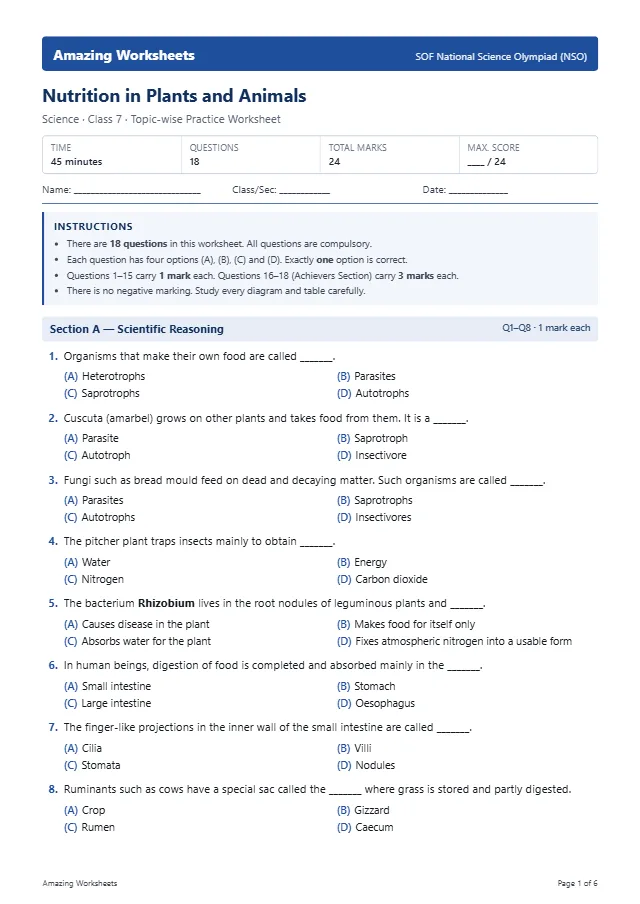
Nutrition in Plants and Animals (Class 7)
Science Olympiad-style practice worksheet on Nutrition in Plants and Animals for Class 7.
Free for personal and classroom use. No sign-up required.
What this worksheet covers
This is an eighteen-question practice worksheet on nutrition in plants and animals for Class 7, written to the pattern of the SOF National Science Olympiad (NSO). It carries 24 marks and is designed to be attempted in 45 minutes, split across three sections — Scientific Reasoning, Applying What You Know and Achievers Section. Every question is multiple choice with exactly one correct option, and every one comes with a fully worked solution rather than just an answer key — so a child who gets one wrong can see where the reasoning went astray instead of only learning that it did.
Skills your child practises
- Applied problem-solving on nutrition in plants and animals at Class 7 level
- Working accurately against a time limit, as the real paper demands
- Scientific Reasoning questions in the olympiad format
- Applying What You Know questions in the olympiad format
- Achievers Section questions in the olympiad format
- Reading worked solutions to find the step that went wrong
How to use it
- 1There are 18 questions in this worksheet. All questions are compulsory.
- 2Each question has four options (A), (B), (C) and (D). Exactly one option is correct.
- 3Questions 1–15 carry 1 mark each. Questions 16–18 (Achievers Section) carry 3 marks each.
- 4There is no negative marking. Study every diagram and table carefully.
Sample questions from this worksheet
A preview of what's inside Nutrition in Plants and Animals (Class 7) — the PDF has the full set, and every question comes with a worked solution like these.
1. Organisms that make their own food are called _______.
- AHeterotrophs
- BParasites
- CSaprotrophs
- DAutotrophscorrect
Solution: Autotrophs make their own food. Green plants do this by photosynthesis, using carbon dioxide, water and sunlight.2. A leaf from a destarched plant is partly covered with black paper and the plant is left in sunlight all day. When the leaf is tested with iodine, the covered part stays pale. What does this show?
- AChlorophyll is not needed
- BWater is not needed
- CCarbon dioxide is not needed
- DSunlight is necessary for the leaf to make starchcorrect
Solution: Iodine turns blue-black wherever starch is present. Both parts of the leaf had the same chlorophyll, air and water; only the light differed. Since only the lit part made starch, sunlight is necessary for the leaf to make starch.3. Consider the following statements.(i) All plants are autotrophic.(ii) Photosynthesis takes place only in the leaves.(iii) Insectivorous plants also carry out photosynthesis.Which of the statements is/are correct?
- A(i) only
- B(iii) onlycorrect
- C(i) and (ii) only
- D(ii) and (iii) only
Solution: Statement (i) is false — Cuscuta has no chlorophyll and is a parasite. Statement (ii) is false; any green part can photosynthesise, and in a cactus it is chiefly the stem. Statement (iii) is true; insectivorous plants are green and make their own food, trapping insects only for nitrogen. Hence (iii) only.
Ready to try the whole paper?
SOF Science Olympiad — Class 7
Topic worksheets build the skill one piece at a time. This mock exam puts them together under a clock, scores itself, and shows the working for every question afterwards.
Love this worksheet?
🏆 Get the Class 7 SOF Practice Bundle
Everything for Class 7: SOF Maths (IMO) and SOF Science (NSO) topic-wise practice worksheets plus full practice exam sets, with answer keys and worked solutions.
View Bundle — ₹79 →