
Earth and the Universe (Class 5)
Science Olympiad-style practice worksheet on Earth and the Universe for Class 5.
Free for personal and classroom use. No sign-up required.
What this worksheet covers
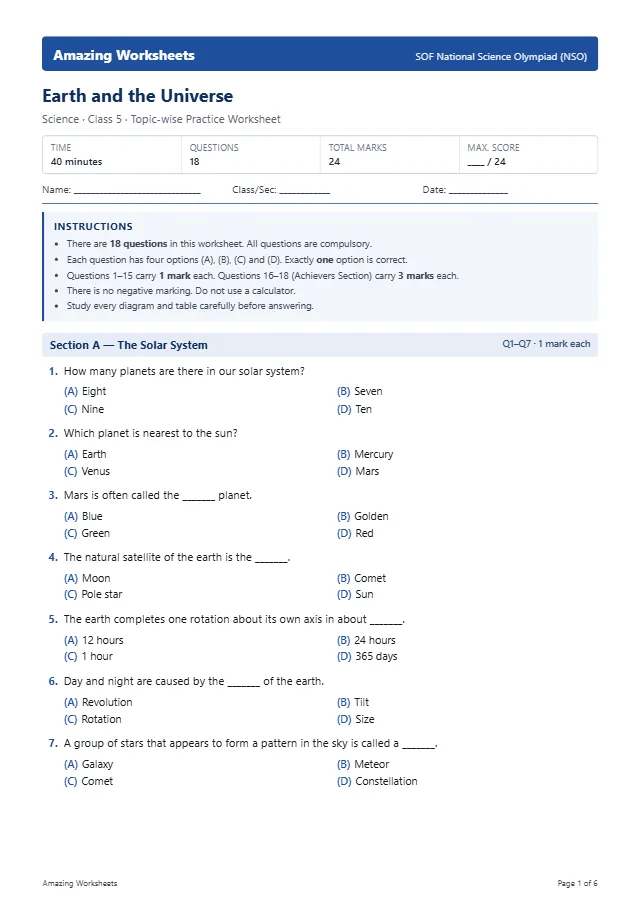
This is an eighteen-question practice worksheet on earth and the universe for Class 5, written to the pattern of the SOF National Science Olympiad (NSO). It carries 24 marks and is designed to be attempted in 40 minutes, split across three sections — The Solar System, Apply and Reason and Achievers Section. Every question is multiple choice with exactly one correct option, and every one comes with a fully worked solution rather than just an answer key — so a child who gets one wrong can see where the reasoning went astray instead of only learning that it did.
Skills your child practises
- Applied problem-solving on earth and the universe at Class 5 level
- Working accurately against a time limit, as the real paper demands
- The Solar System questions in the olympiad format
- Apply and Reason questions in the olympiad format
- Achievers Section questions in the olympiad format
- Reading worked solutions to find the step that went wrong
How to use it
- 1There are 18 questions in this worksheet. All questions are compulsory.
- 2Each question has four options (A), (B), (C) and (D). Exactly one option is correct.
- 3Questions 1–15 carry 1 mark each. Questions 16–18 (Achievers Section) carry 3 marks each.
- 4There is no negative marking. Do not use a calculator.
- 5Study every diagram and table carefully before answering.
Sample questions from this worksheet
A preview of what's inside Earth and the Universe (Class 5) — the PDF has the full set, and every question comes with a worked solution like these.
1. How many planets are there in our solar system?
- AEightcorrect
- BSeven
- CNine
- DTen
Solution: There are eight planets: Mercury, Venus, Earth, Mars, Jupiter, Saturn, Uranus and Neptune. Pluto was counted as the ninth planet until 2006, when it was reclassified as a dwarf planet.2. Assertion (A): From the earth we always see the same side of the moon.Reason (R): The moon takes the same time to rotate once on its axis as it takes to revolve once around the earth.Choose the correct option.
- ABoth A and R are true, and R explains Acorrect
- BBoth A and R are true, but R does not explain A
- CA is true but R is false
- DA is false but R is true
Solution: Both statements are true. Because one rotation of the moon takes exactly as long as one trip around the earth (about 27 days), the same face is always turned towards us. That matching of the two periods is precisely the reason, so R explains A.3. Consider the following statements.(i) The moon produces its own light.(ii) The tilt of the earth's axis, together with its revolution, causes the seasons.(iii) The sun is the nearest star to the earth.Which of the statements is/are correct?
- A(i) and (ii) only
- B(ii) and (iii) onlycorrect
- C(i) and (iii) only
- DAll three
Solution: Statement (i) is false — the moon has no light of its own and merely reflects sunlight. Statement (ii) is true; because the axis is tilted, different parts of the earth lean towards the sun at different points in the year, giving summer and winter. Statement (iii) is true; the sun is about 150 million km away, while the next nearest star is thousands of times further. Hence (ii) and (iii).
Ready to try the whole paper?
SOF Science Olympiad — Class 5
Topic worksheets build the skill one piece at a time. This mock exam puts them together under a clock, scores itself, and shows the working for every question afterwards.
Love this worksheet?
🏆 Get the Class 5 SOF Practice Bundle
Everything for Class 5: SOF Maths (IMO) and SOF Science (NSO) topic-wise practice worksheets plus full practice exam sets, with answer keys and worked solutions.
View Bundle — ₹79 →