
Cell Tissues and Diversity in Living Organisms (Class 9)
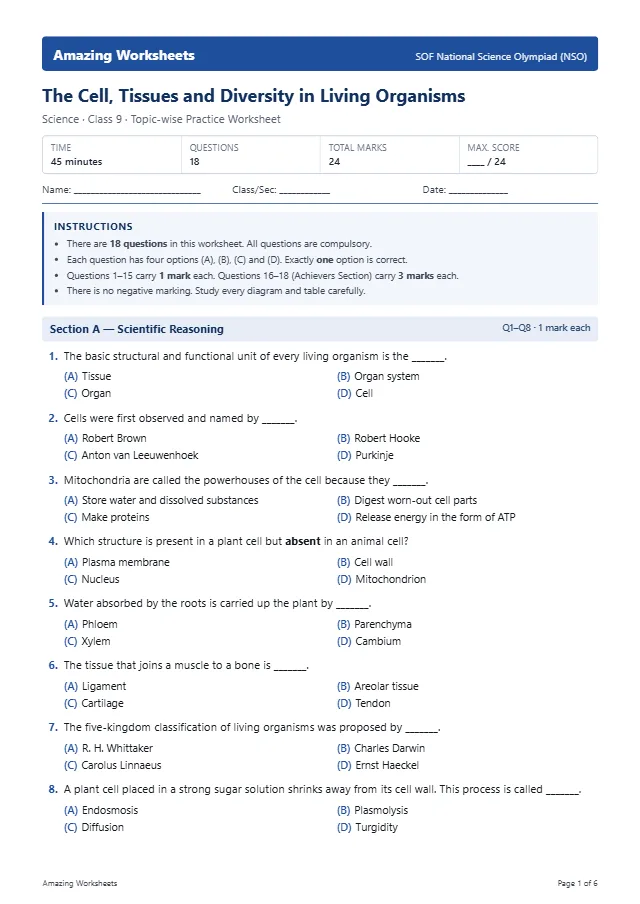
Science Olympiad-style practice worksheet on Cell Tissues and Diversity in Living Organisms for Class 9.
Free for personal and classroom use. No sign-up required.
What this worksheet covers
This is an eighteen-question practice worksheet on the cell, tissues and diversity in living organisms for Class 9, written to the pattern of the SOF National Science Olympiad (NSO). It carries 24 marks and is designed to be attempted in 45 minutes, split across three sections — Scientific Reasoning, Applying What You Know and Achievers Section. Every question is multiple choice with exactly one correct option, and every one comes with a fully worked solution rather than just an answer key — so a child who gets one wrong can see where the reasoning went astray instead of only learning that it did.
Skills your child practises
- Applied problem-solving on the cell, tissues and diversity in living organisms at Class 9 level
- Working accurately against a time limit, as the real paper demands
- Scientific Reasoning questions in the olympiad format
- Applying What You Know questions in the olympiad format
- Achievers Section questions in the olympiad format
- Reading worked solutions to find the step that went wrong
How to use it
- 1There are 18 questions in this worksheet. All questions are compulsory.
- 2Each question has four options (A), (B), (C) and (D). Exactly one option is correct.
- 3Questions 1–15 carry 1 mark each. Questions 16–18 (Achievers Section) carry 3 marks each.
- 4There is no negative marking. Study every diagram and table carefully.
Sample questions from this worksheet
A preview of what's inside Cell Tissues and Diversity in Living Organisms (Class 9) — the PDF has the full set, and every question comes with a worked solution like these.
1. The basic structural and functional unit of every living organism is the _______.
- ATissue
- BOrgan system
- COrgan
- DCellcorrect
Solution: The cell is the smallest unit that can carry out all the activities of life on its own. Tissues, organs and organ systems are all built up from cells.2. Blood is classified as a _______.
- AEpithelial tissue
- BMuscular tissue
- CConnective tissuecorrect
- DNervous tissue
Solution: Blood is a connective tissue: its cells are suspended in a fluid matrix called plasma, and it links the different parts of the body by transporting gases, food, wastes and hormones.3. Assertion (A): Mitochondria and plastids are able to make some of their own proteins.Reason (R): They possess their own DNA and ribosomes.
- ABoth A and R are true and R is the correct explanation of Acorrect
- BBoth A and R are true but R is not the correct explanation of A
- CA is true but R is false
- DA is false but R is true
Solution: Both organelles carry a small circular DNA molecule together with ribosomes, and this genetic machinery lets them build some of their own proteins. Both statements are true, and possessing DNA and ribosomes is precisely why they can do so, so R explains A.
Ready to try the whole paper?
SOF Science Olympiad — Level 4 (Free Practice Set)
Topic worksheets build the skill one piece at a time. This mock exam puts them together under a clock, scores itself, and shows the working for every question afterwards.
Love this worksheet?
🏆 Get the Class 9 SOF Practice Bundle
Everything for Class 9: SOF Maths (IMO) and SOF Science (NSO) topic-wise practice worksheets plus full practice exam sets, with answer keys and worked solutions.
View Bundle — ₹79 →