
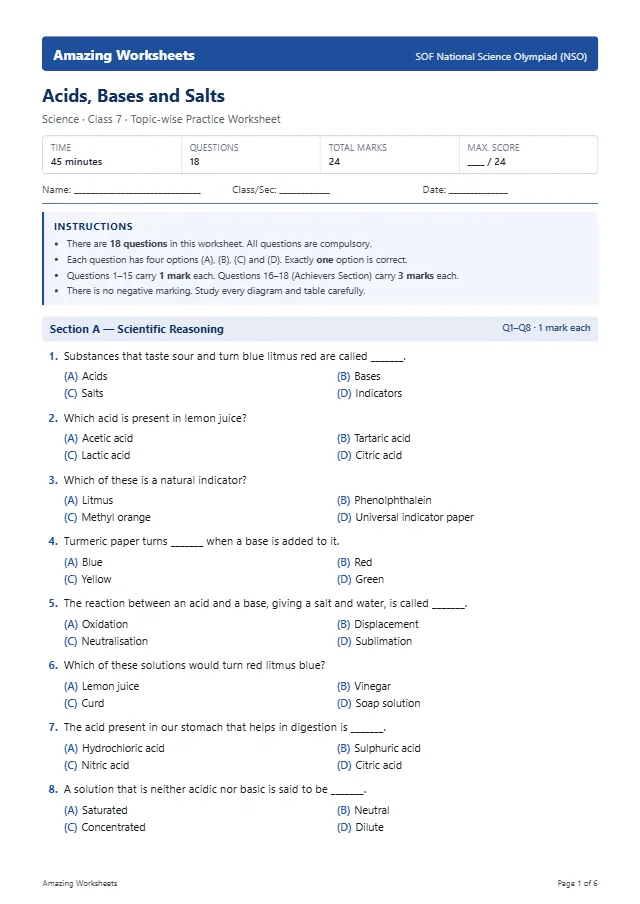
Acids Bases and Salts (Class 7)
Science Olympiad-style practice worksheet on Acids Bases and Salts for Class 7.
Free for personal and classroom use. No sign-up required.
What this worksheet covers
This is an eighteen-question practice worksheet on acids, bases and salts for Class 7, written to the pattern of the SOF National Science Olympiad (NSO). It carries 24 marks and is designed to be attempted in 45 minutes, split across three sections — Scientific Reasoning, Applying What You Know and Achievers Section. Every question is multiple choice with exactly one correct option, and every one comes with a fully worked solution rather than just an answer key — so a child who gets one wrong can see where the reasoning went astray instead of only learning that it did.
Skills your child practises
- Applied problem-solving on acids, bases and salts at Class 7 level
- Working accurately against a time limit, as the real paper demands
- Scientific Reasoning questions in the olympiad format
- Applying What You Know questions in the olympiad format
- Achievers Section questions in the olympiad format
- Reading worked solutions to find the step that went wrong
How to use it
- 1There are 18 questions in this worksheet. All questions are compulsory.
- 2Each question has four options (A), (B), (C) and (D). Exactly one option is correct.
- 3Questions 1–15 carry 1 mark each. Questions 16–18 (Achievers Section) carry 3 marks each.
- 4There is no negative marking. Study every diagram and table carefully.
Sample questions from this worksheet
A preview of what's inside Acids Bases and Salts (Class 7) — the PDF has the full set, and every question comes with a worked solution like these.
1. Substances that taste sour and turn blue litmus red are called _______.
- AAcidscorrect
- BBases
- CSalts
- DIndicators
Solution: Acids taste sour and turn blue litmus red. Bases taste bitter, feel soapy and turn red litmus blue.2. A person suffering from acidity is given an antacid such as milk of magnesia. How does it work?
- AIt adds more acid to the stomach
- BIt coats the stomach with fat
- CIt is a mild base that neutralises the excess acidcorrect
- DIt makes the person vomit
Solution: Milk of magnesia is magnesium hydroxide, a mild base that neutralises the excess hydrochloric acid in the stomach, giving relief. This is neutralisation put to everyday use.3. Consider the following statements.(i) All acids are dangerous and cannot be eaten.(ii) Neutralisation always produces a salt and water.(iii) Distilled water is neutral to litmus.Which of the statements is/are correct?
- A(i) and (ii) only
- B(ii) and (iii) onlycorrect
- C(i) and (iii) only
- DAll three
Solution: Statement (i) is false — many acids are perfectly safe to eat, such as the citric acid in lemons and the acetic acid in vinegar; it is strong mineral acids that are dangerous. Statements (ii) and (iii) are both true. Hence (ii) and (iii).
Ready to try the whole paper?
SOF Science Olympiad — Class 7
Topic worksheets build the skill one piece at a time. This mock exam puts them together under a clock, scores itself, and shows the working for every question afterwards.
Love this worksheet?
🏆 Get the Class 7 SOF Practice Bundle
Everything for Class 7: SOF Maths (IMO) and SOF Science (NSO) topic-wise practice worksheets plus full practice exam sets, with answer keys and worked solutions.
View Bundle — ₹79 →