
Quadrilaterals Areas and Circles (Class 9)
Maths Olympiad-style practice worksheet on Quadrilaterals Areas and Circles for Class 9.
Free for personal and classroom use. No sign-up required.
What this worksheet covers
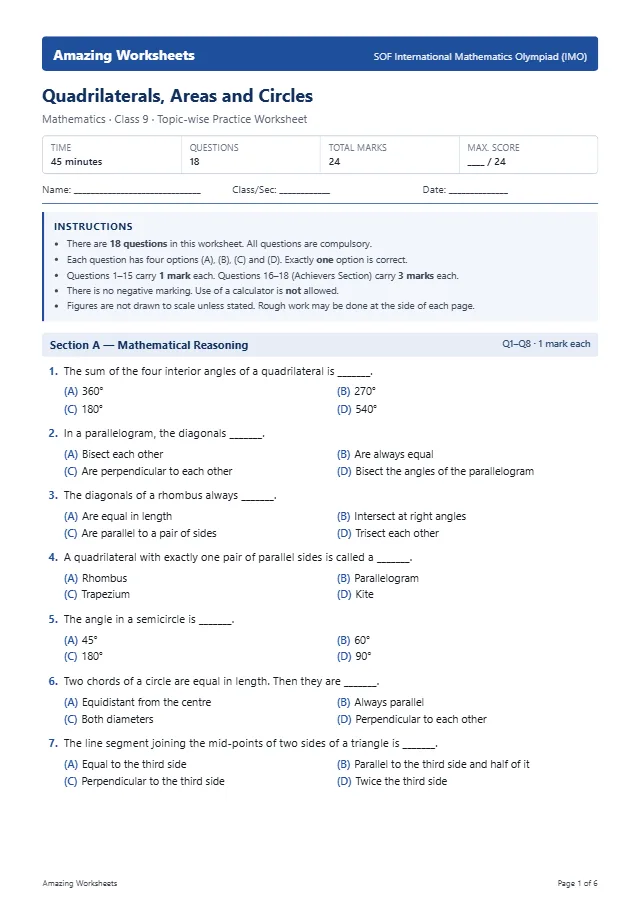
This is an eighteen-question practice worksheet on quadrilaterals, areas and circles for Class 9, written to the pattern of the SOF International Mathematics Olympiad (IMO). It carries 24 marks and is designed to be attempted in 45 minutes, split across three sections — Mathematical Reasoning, Everyday Mathematics and Reasoning and Achievers Section. Every question is multiple choice with exactly one correct option, and every one comes with a fully worked solution rather than just an answer key — so a child who gets one wrong can see where the reasoning went astray instead of only learning that it did.
Skills your child practises
- Applied problem-solving on quadrilaterals, areas and circles at Class 9 level
- Working accurately against a time limit, as the real paper demands
- Mathematical Reasoning questions in the olympiad format
- Everyday Mathematics and Reasoning questions in the olympiad format
- Achievers Section questions in the olympiad format
- Reading worked solutions to find the step that went wrong
How to use it
- 1There are 18 questions in this worksheet. All questions are compulsory.
- 2Each question has four options (A), (B), (C) and (D). Exactly one option is correct.
- 3Questions 1–15 carry 1 mark each. Questions 16–18 (Achievers Section) carry 3 marks each.
- 4There is no negative marking. Use of a calculator is not allowed.
- 5Figures are not drawn to scale unless stated. Rough work may be done at the side of each page.
Sample questions from this worksheet
A preview of what's inside Quadrilaterals Areas and Circles (Class 9) — the PDF has the full set, and every question comes with a worked solution like these.
1. The sum of the four interior angles of a quadrilateral is _______.
- A360°correct
- B270°
- C180°
- D540°
Solution: A diagonal splits any quadrilateral into two triangles, each contributing 180°. So the four angles total 2 × 180° = 360°.2. A triangle and a parallelogram stand on the same base and between the same pair of parallel lines. If the area of the parallelogram is 84 cm², the area of the triangle is _______.
- A84 cm²
- B42 cm²correct
- C168 cm²
- D28 cm²
Solution: Both figures share the same base b and the same height h, since the parallel lines fix the distance between them. The parallelogram has area bh and the triangle {1/2}bh, so the triangle’s area is half: 84 ÷ 2 = 42 cm².3. In parallelogram ABCD, ∠A and ∠B are in the ratio 4 : 5. The measure of ∠C is _______.
- A90°
- B80°correct
- C100°
- D120°
Solution: Adjacent angles of a parallelogram are supplementary, so 4k + 5k = 180°, giving 9k = 180° and k = 20°. Thus ∠A = 80° and ∠B = 100°. Opposite angles are equal, so ∠C = ∠A = 80°.
Ready to try the whole paper?
SOF Math Olympiad — Level 4 (Free Practice Set)
Topic worksheets build the skill one piece at a time. This mock exam puts them together under a clock, scores itself, and shows the working for every question afterwards.
Love this worksheet?
🏆 Get the Class 9 SOF Practice Bundle
Everything for Class 9: SOF Maths (IMO) and SOF Science (NSO) topic-wise practice worksheets plus full practice exam sets, with answer keys and worked solutions.
View Bundle — ₹79 →