
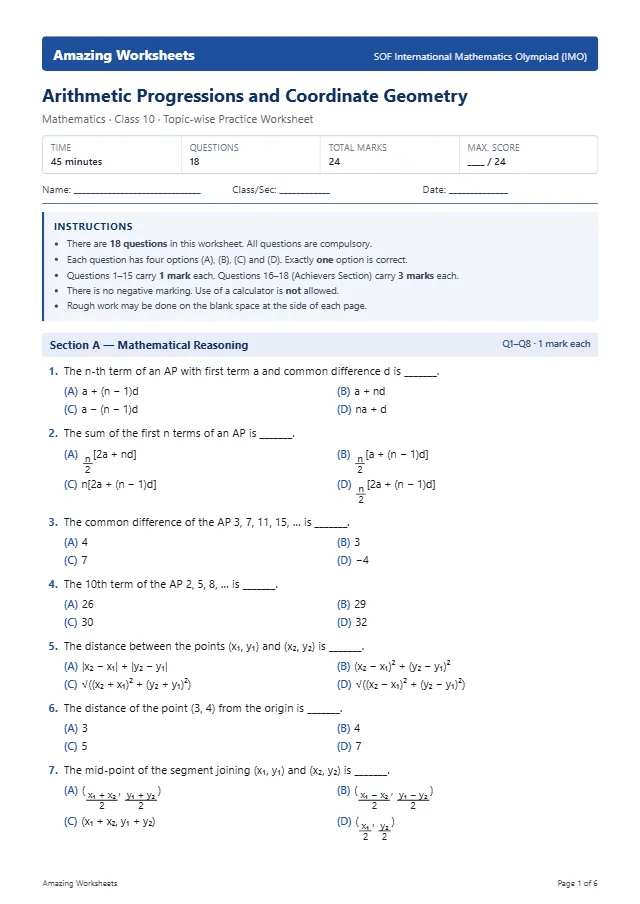
Arithmetic Progressions and Coordinate Geometry (Class 10)
Maths Olympiad-style practice worksheet on Arithmetic Progressions and Coordinate Geometry for Class 10.
Free for personal and classroom use. No sign-up required.
What this worksheet covers
This is an eighteen-question practice worksheet on arithmetic progressions and coordinate geometry for Class 10, written to the pattern of the SOF International Mathematics Olympiad (IMO). It carries 24 marks and is designed to be attempted in 45 minutes, split across three sections — Mathematical Reasoning, Everyday Mathematics and Reasoning and Achievers Section. Every question is multiple choice with exactly one correct option, and every one comes with a fully worked solution rather than just an answer key — so a child who gets one wrong can see where the reasoning went astray instead of only learning that it did.
Skills your child practises
- Applied problem-solving on arithmetic progressions and coordinate geometry at Class 10 level
- Working accurately against a time limit, as the real paper demands
- Mathematical Reasoning questions in the olympiad format
- Everyday Mathematics and Reasoning questions in the olympiad format
- Achievers Section questions in the olympiad format
- Reading worked solutions to find the step that went wrong
How to use it
- 1There are 18 questions in this worksheet. All questions are compulsory.
- 2Each question has four options (A), (B), (C) and (D). Exactly one option is correct.
- 3Questions 1–15 carry 1 mark each. Questions 16–18 (Achievers Section) carry 3 marks each.
- 4There is no negative marking. Use of a calculator is not allowed.
- 5Rough work may be done on the blank space at the side of each page.
Sample questions from this worksheet
A preview of what's inside Arithmetic Progressions and Coordinate Geometry (Class 10) — the PDF has the full set, and every question comes with a worked solution like these.
1. The n-th term of an AP with first term a and common difference d is _______.
- Aa + (n − 1)dcorrect
- Ba + nd
- Ca − (n − 1)d
- Dna + d
Solution: Starting from a, the common difference has been added n − 1 times by the time the n-th term is reached, so an = a + (n − 1)d.2. Which of the following lists of numbers forms an AP?
- A1, 4, 7, 10, …correct
- B2, 4, 8, 16, …
- C1, 4, 9, 16, …
- D3, 6, 12, 24, …
Solution: An AP needs the same difference between consecutive terms. In 1, 4, 7, 10 that difference is always 3. The other lists double each time or are the perfect squares, whose differences 3, 5, 7 keep growing.3. How many two-digit numbers are divisible by 3?
- A29
- B30correct
- C31
- D33
Solution: Such numbers form the AP 12, 15, …, 99 with d = 3. From 99 = 12 + (n − 1)(3) we get 87 = 3(n − 1), so n − 1 = 29 and n = 30.
Ready to try the whole paper?
SOF Math Olympiad — Level 5 (Free Practice Set)
Topic worksheets build the skill one piece at a time. This mock exam puts them together under a clock, scores itself, and shows the working for every question afterwards.
Love this worksheet?
🏆 Get the Class 10 SOF Practice Bundle
Everything for Class 10: SOF Maths (IMO) and SOF Science (NSO) topic-wise practice worksheets plus full practice exam sets, with answer keys and worked solutions.
View Bundle — ₹79 →