
The SOF IMO Class 4 Syllabus, Explained for Parents
What the four sections of the International Mathematics Olympiad paper actually test at Class 4, how the marks are distributed, and a realistic twelve-week preparation plan.
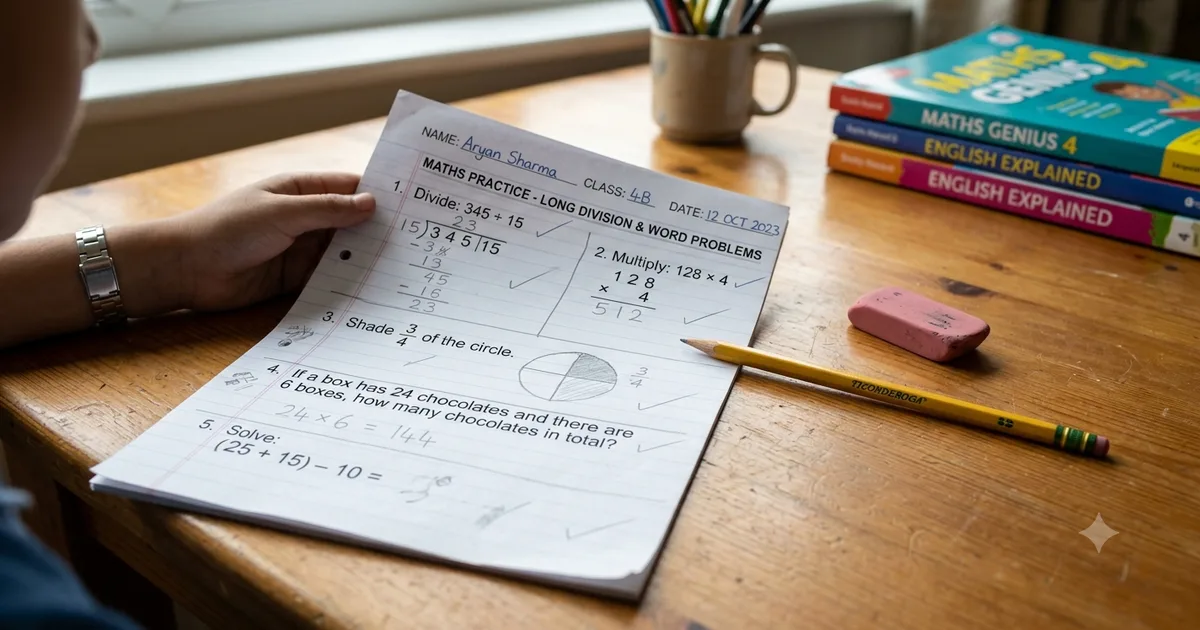
The International Mathematics Olympiad run by the Science Olympiad Foundation is the first competitive maths exam most Indian children sit, and Class 4 is the year the paper changes character. The arithmetic is not much harder than school. What is harder is that the questions stop telling you what to do.
This guide covers what the paper contains, where children actually lose marks, and how to prepare over a term without turning maths into a chore.
Check the current brochure before you plan. SOF adjusts the pattern from time to time — question counts, marks and the syllabus for a given class have all changed in past years. Treat the structure below as the shape of the paper, and confirm this year's specifics on the official SOF website before building a timetable around them.
How the paper is built
The Class 4 paper is multiple choice throughout, with four options per question and exactly one correct answer. It is split into four sections, and they are not equally weighted:
Logical Reasoning. Patterns, series, odd-one-out, coding and decoding, mirror images, ranking and direction sense. Very little of this is taught in a Class 4 maths lesson, which is precisely why it separates candidates. A child seeing this type of question for the first time in the exam hall will lose marks they were perfectly capable of earning.
Mathematical Reasoning. The school syllabus, asked less directly: large numbers and place value, the four operations, factors and multiples, fractions, measurement, geometry, time and money. If your child is comfortable in class, the content here holds no surprises — the phrasing does.
Everyday Mathematics. The same maths wrapped in word problems and real situations — shopping, timetables, measurement in context, reading data from a table or pictograph. This is where careless reading costs the most marks.
Achievers Section. A small number of questions carrying three marks each instead of one. Multi-step problems that combine two or three ideas. Because of the weighting, these few questions can be worth as much as ten ordinary ones, and they are the difference between a good score and a rank.
Both the number of questions and the total marks have varied between years and classes, so take those figures from the current brochure rather than from any guide, this one included.
Where marks are actually lost
Having looked at a lot of Class 4 practice papers, the same four leaks appear again and again — and only one of them is about mathematical ability.
Reading the question wrongly. "How many more" answered as "how many". A total when the question asked for a difference. This is comfortably the largest single cause of lost marks at this level, and it is trained away by habit, not by more maths.
Unit slips. Answers left in metres when the options are in centimetres, or minutes where the question asked for hours. The wrong-unit answer is almost always one of the four options, deliberately.
Abandoning the Achievers Section. Children run out of time, reach the three-mark questions last, and rush them. Reversing that order — glancing at the Achievers questions early, even just to know what is coming — is worth real marks.
Guessing badly. There is normally no negative marking, which means every blank is a wasted opportunity. A child should never leave an answer empty. But a considered guess after eliminating two options is worth far more than a random one, and elimination is a teachable skill.
A twelve-week plan
This assumes about three sessions a week of thirty to forty minutes. More than that, at this age, tends to produce diminishing returns and a child who dislikes maths.
Weeks 1–3 — establish the baseline. One topic per session from the Mathematical Reasoning list, worked slowly with full written steps. No timing yet. The aim is accuracy and the habit of showing work, not speed.
Weeks 4–6 — logical reasoning. Treat this as its own subject, because school will not cover it. Patterns and series first, then coding/decoding, then mirror images and direction sense. Most children find these genuinely enjoyable once the trick of each type is visible.
Weeks 7–9 — word problems under mild time pressure. Everyday Mathematics questions with a clock running, but generously — aim for about a minute and a half per question, not the exam's pace. Introduce the underline habit here: underline what the question is actually asking for before starting any calculation. This single routine fixes most of the misreading errors.
Weeks 10–11 — full papers, properly timed. Two or three complete papers under real conditions, in one sitting, no interruptions. Mark them together afterwards, and spend longer on the review than on the paper itself. Every wrong answer gets one question: was this a maths mistake or a reading mistake? The tally is usually revealing.
Week 12 — light revision only. Re-work the questions that were wrong in weeks 10 and 11, and nothing new. Cramming new topics in the last week reliably lowers scores.
Practising with worked solutions
The most useful property of a practice worksheet is not its difficulty — it is whether it explains the answers. An answer key tells a child they were wrong. A worked solution shows them where the reasoning went off, which is the only part that transfers to the next question.
Our SOF maths practice worksheets are written to the olympiad pattern, one topic at a time, and every question carries a full worked solution rather than a bare answer letter. Each sheet's page shows sample questions with their solutions so you can see the level before printing anything, and there are free practice exams if you want a timed attempt with automatic marking.
Keeping it proportionate
A Class 4 olympiad is practice at thinking, not a verdict on a nine-year-old. The children who do well are usually the ones who found the questions interesting, not the ones who did the most papers. If preparation starts producing tears, cut the volume in half — the score will not suffer nearly as much as you would expect, and the child's willingness to try again next year will survive intact.